
October 14, 2007
If you have to wheel out your BBQ grill every time you use it, it won't get used. That was the lesson we learned just after moving into this house, when I stored our brand-new natural-gas grill out in the (detached) garage next to Squeeky's car.
First, I'd have to move the car. Then tug the grill out and roll it on its hard, plastic wheels up the driveway, through the gate, and across the patio to the house, where the gas-line fitting was.
That lasted about six dinners.
Then I just started leaving it next to the house, where it got in the way of everything, especially rain. Not eager to see $400 rust out onto the patio, I poked around the Web for an extension of the rubber gas line, so I could move the unit to a protected spot under the eaves. Such hoses start about $100 for 12 feet, including adapters. Nuts.
So I studied the gas-line tee I'd installed just after move-in for some way of extending it into the ground, then a couple of feet south, 10 feet west, then up a foot. This would take all the spatial thinking Rittenhouse could muster, plus about $40 in pipe and fittings.
Housketeers will already know I am fearless when it comes to gas and electricity. Noobs, take note: Try this at home and you'll probably get killed.
the quirky thing about running gas pipe is, you have to start at the source (in this case, the L where the line rose from the ground to the house), then work your way out to the appliance. You can't start the other way, and you can't start at both ends and meet in the middle. The simple reason is, the fittings only tighten clockwise. If you build toward the main line, you'll end up undoing all you've done because the last right-hand turn unscrews the previous one. Then you have to start all over.
 Also, pipes only bend 90 degrees. There are 45-degree couplings, but I don't swing that way.
Perhaps this is better illustrated than written about.
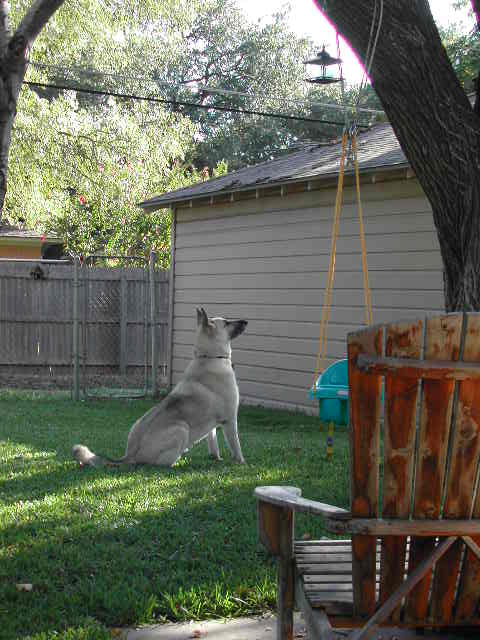
The first consideration, as always, is safety. I stationed Wolf Dog behind me to keep predators at bay.
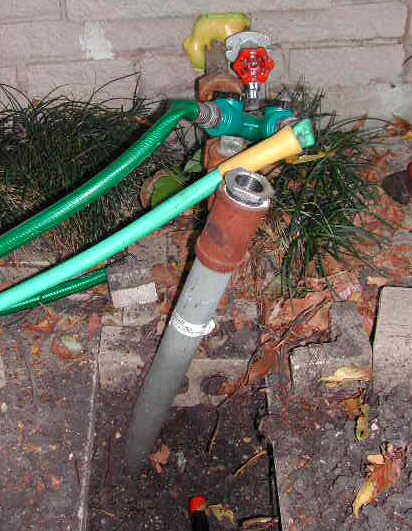 Here's the gray plastic gas line coming out of the ground at a crazy angle I can't change. The rusty thing is a tee. The main branch enters the house at the yellow foam blob next to the garden hoses. The shiny silver hex-nut-looking thing in the foreground is a step-down adapter. I would have to get creative with adapters and angles to go from about a 1-inch to a ½-inch line heading the opposite direction.
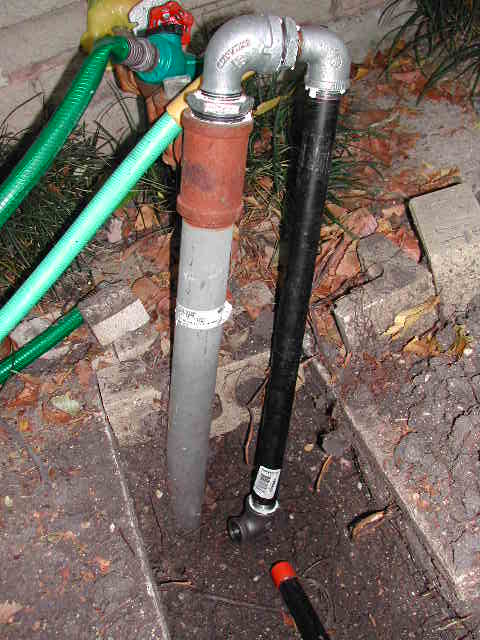 Here's how that worked out (right). I switched to black iron pipe entering the soil because somebody told me that was better than regular zinc.
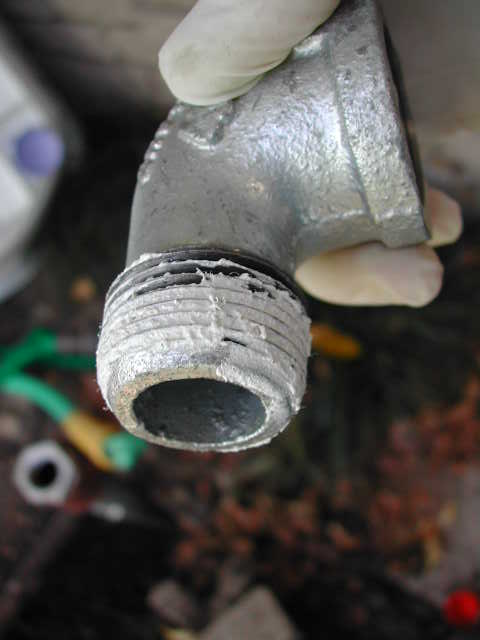 I wanted to use Teflon tape on all the connections, because—inexplicably—I have about 26 rolls of it, but couldn't find a recommendation. The white stuff here is pipe goop.
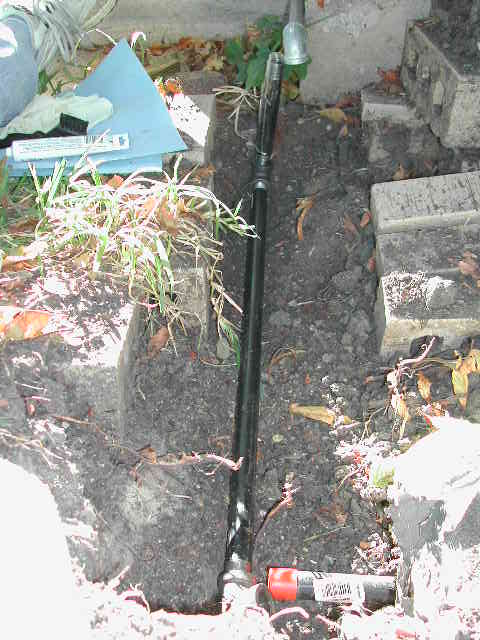 I pickaxed a trench through ground that some previous owner had bricked over. At right, here's where the black pipe angles west 90 degrees (orange cap where an L would later go), then upward to a zinc fitting for another 90-degree bend. We're almost to the homestretch.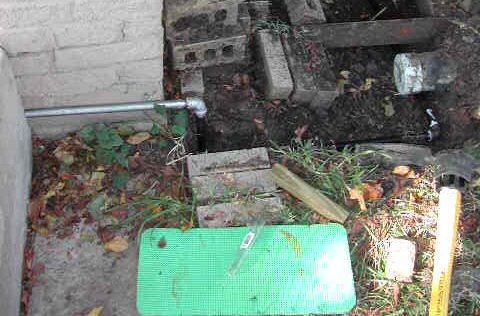
Looking north again, up there's the zinc pipe where it takes over from the black pipe, continuing west behind the concrete steps leading to the back door. This part would remain exposed; there was no way around that without a jackhammer and two more Saturdays.
The tricky part was driving the pipe through the narrow gap between stoop and foundation without damaging its threads. The protective plastic cover barely made it through in one piece. (Note green kneeling pad for knees that have lost their ability to recover from abuse.)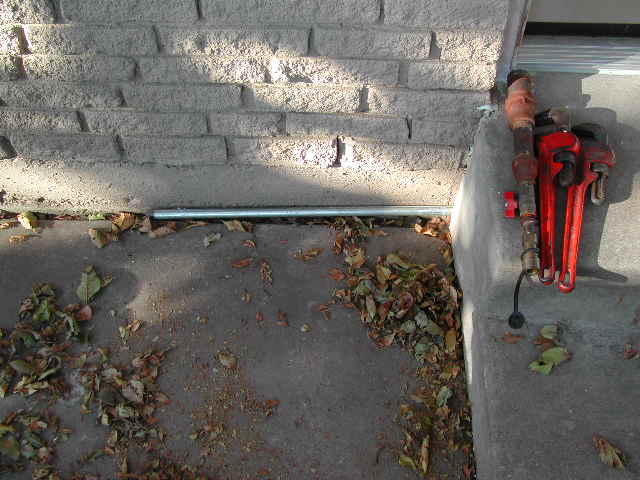
The pipe emerges safely, awaiting final adaptor, at left.
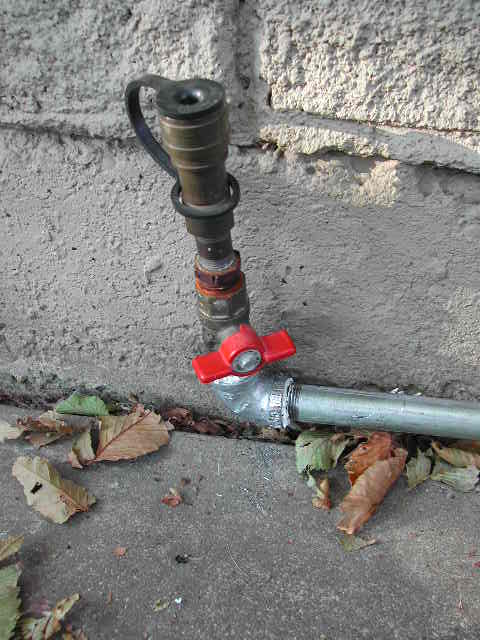 At right, the quick-connect fitting is from the Marshall Company in Detroit. During its first winter here, I had been taking the rubber cap on and off so frequently that it cracked. I called their office and was greeted by a friendly secretary, who promptly mailed me a replacement cap free, no questions asked. I liked them so much I forgot to ask if they knew Marshall Mathers.
Here's the final, blurry shot of the bricking after I restored its original lustre. Pipe buried and extended, permit not sought, inspection not bothered with, and—surprise—no leaks!
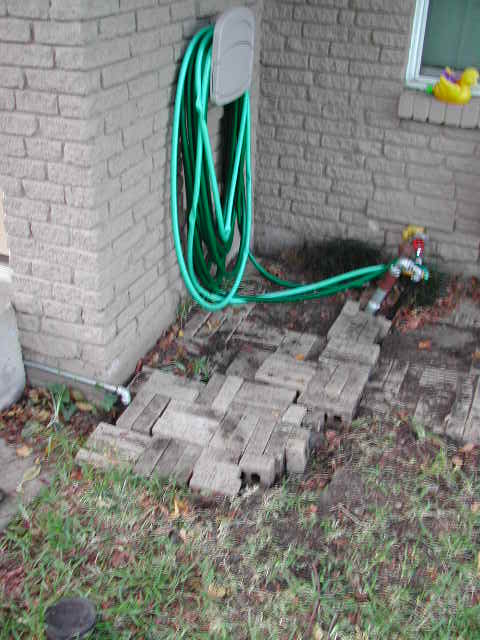
Don't let anyone scare you that gas lines are something complicated. If you can think geometrically and own two pipe wrenches, you can build stuff with pipe. Just don't tell anyone you learned how from some communications major on the Internets.
Posted by: Michael Rittenhouse at
07:35 PM
| Comments (7)
| Add Comment
Post contains 795 words, total size 7 kb.
Galvanized used to be considered a no-no for gas line, but underground, it makes a lot of sense to me.
Our local utility uses plastic or rubber coated pipe underground and painted black above. Most contractors use black or plastic indoors, and definitely plastic underground. You probably overspent by about $20.
So long as you can cook, don't sweat it, nice job.
Posted by: og at October 21, 2007 12:45 PM (1xdKD)
Posted by: Ric Locke at October 21, 2007 10:22 PM (2g+gT)
Remember the old TV show The Munsters? Remember the pet/dragon under the stairs. Is your backyard belching flame like that creature?
What is that festival they have out in the desert southwest evey year where they spend all week burning stuff? Do people show up in your yard thinking the festival has begun?
Well, I'm impressed.
Neighbors roll up the fire hoses!
Only you can prevent.....you get the idea.
Sanders
Posted by: Sanders at October 22, 2007 09:17 PM (3KsYa)
Posted by: Sanders at October 22, 2007 09:19 PM (3KsYa)
WHOA.......WHOA...... black pipe was nver intended to be underground or in wet damp conditions. Galvanized is ok for gas but only above ground and properly labled.
Gas in ground/wet/moist is to be run in coated pipe with a protective tape applied at exposed threads and fittings.
You have made a bomb. Another case of home owner/amature out smarting the tradesman. Who are you going to sue? You did it wrong .........
Posted by: desertman at October 23, 2007 06:15 AM (hn6sr)
I think you have offended Dessert Man.
The business card for Dessert Man Plumbing is on your door as we speak.
"You have made a bomb."
Now THAT is kinda cool.
"Out smarting the tradesman."
That doesn't sound TOO difficult to do.
The bomb WILL get rid of those pesky fire ants!
OK it is out of my system.
For now.
Sanders
Posted by: Sanders at October 24, 2007 12:40 AM (6mUkl)
Based on experience with them, I do not automatically rank the work of "tradesmen" above my own.
As the houses around mine have changed hands several times, I've seen (for example) $13,000 of "professional" electrical work that had to be re-done for compliance. The code didn't change.
The licensed plumber I hired to replace my sewer line dug about 20 feet of excess trench searching for the connection I had clearly pointed out for him, killing a 50-year-old tree. Then, contrary to my explicit directions, he spread the backfill out over the lawn, killing 50 years' growth of St. Augustine that has never recovered.
And, at Big Box Home Improvement, I've stood in line with "tradesmen" pushing a cart full of Alex caulk, the cheap stuff that one only buys to shave margins. I do not want to see what those joints look like after 12 months of weather.
So, if the 8-10 feet of black pipe I set outdoors under a few inches of soil rusts through in about 20 years (less than half what the pipe laid under the house in 1956 has withstood), I'll link back to this post for my I-told-you-so's.
Posted by: Michael Rittenhouse at October 25, 2007 05:19 AM (78u8A)
23 queries taking 0.0278 seconds, 24 records returned.
Powered by Minx 1.1.6c-pink.